Travel guide
What to eat, country by country
Six countries that share a shopping list and almost nothing else. This is what is worth building a day around, where to find it, and how to eat well without spending the trip being careful.
Food
The same ingredients, six different arguments
Rice, fish sauce or its local cousin, lemongrass, chilli, lime and a pot of herbs sit behind almost everything eaten between Hanoi and Manila. What differs is the balance: how much sugar, how much sourness, whether the heat is fresh chilli or dried, whether coconut milk is a foundation or an intruder. Those arguments run inside countries as much as between them, and they are the reason a fortnight here can be eaten rather than merely toured.
The practical advice that follows from that is simple. Eat lunch where the people who work nearby eat, book dinner only where you actually want to, and spend one morning per country in a market with somebody who can tell you what you are looking at. That last one is worth more than any restaurant reservation we could make for you.

Vietnam
Vietnam: three kitchens, not one
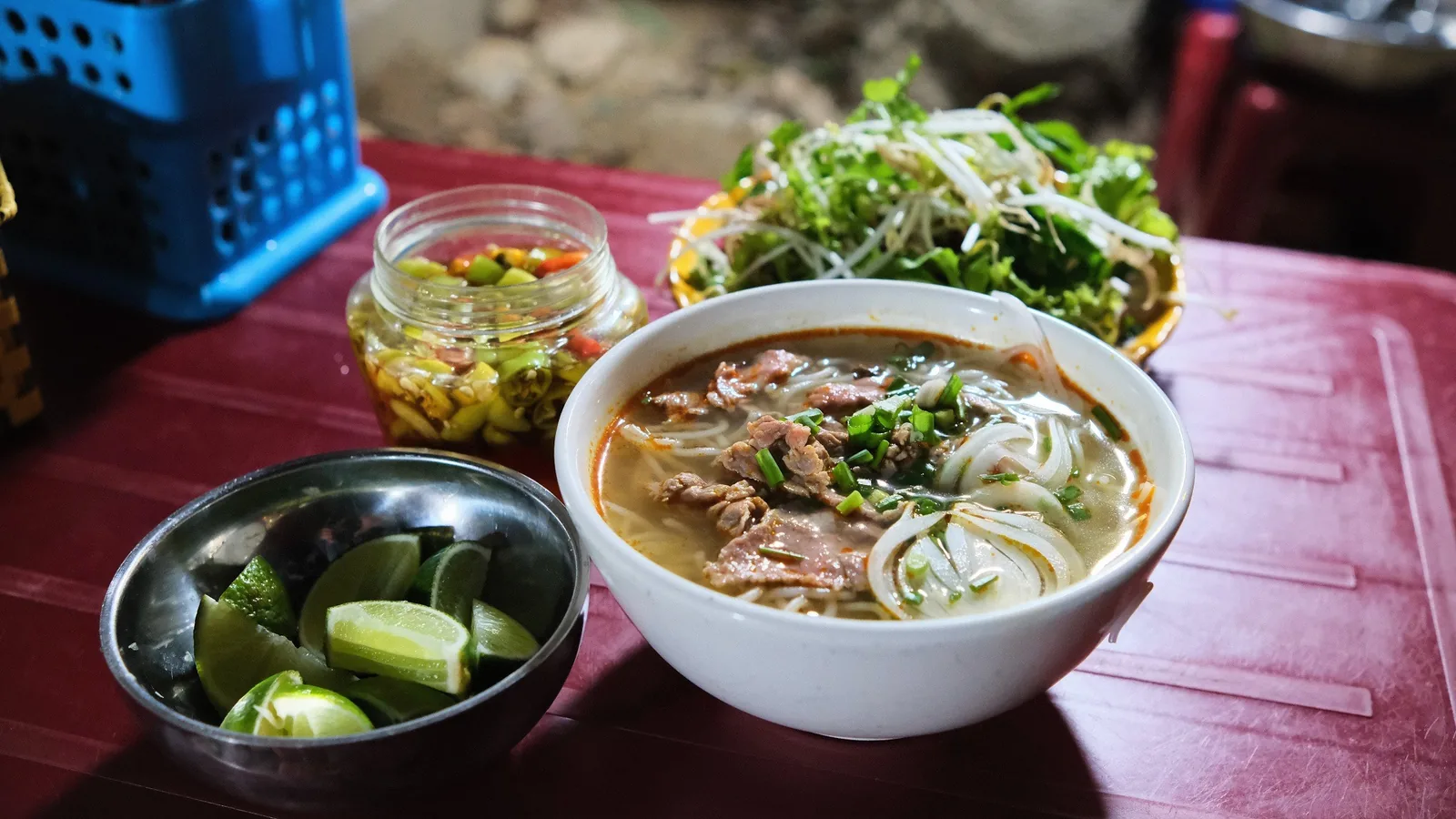
Northern Vietnamese food is the restrained version — less sugar, less chilli, more dill and black pepper, and freshwater fish rather than sea fish. Hanoi is where to eat pho, which arrives clear and plain with the herbs on the side rather than heaped in; bun cha, grilled pork in a bowl of sweet-sour broth, eaten at lunchtime and almost never in the evening; cha ca, turmeric fish fried at the table with dill; and banh cuon, steamed rice sheets that are a breakfast rather than a starter.
Central Vietnam is the fussiest and the most interesting. Hue cooks small, elaborate dishes out of an imperial tradition — banh beo, banh nam and banh loc, rice cakes the size of a coin — alongside bun bo Hue, a lemongrass and chilli beef soup that is the opposite of Hanoi pho. Hoi An has cao lau, thick noodles that exist nowhere else, and a banh mi culture that rewards queueing.
Southern food is sweeter, greener and more generous with coconut milk and herbs. Com tam, broken rice with grilled pork, is the working lunch of Ho Chi Minh City. Banh xeo in the south is a large turmeric crêpe you wrap in lettuce and herbs yourself. The Mekong Delta adds river fish, snakehead and elephant ear fish eaten straight off the frame.
Thailand
Thailand: central sweetness, Isan salt and sourness
Central Thai cooking is the one exported around the world: coconut curries, tom yum, and a balance that runs sweet before it runs hot. It is at its best in Bangkok, where the range from a pavement wok to a serious kitchen is wider than anywhere else in the region.
Isan, the northeast, is a different cuisine with a Lao parentage. It is built on sticky rice eaten by hand, som tam pounded to order, larb — minced meat with toasted rice powder, lime and mint — and charcoal-grilled chicken. There is little coconut milk and a great deal of chilli, lime and fermented fish. If Thai food has always struck you as too sweet, Isan is the correction.
The north has its own kitchen again: khao soi, a curried noodle soup with crisp noodles on top, is Chiang Mai’s dish, and the northern sausage sai ua and the chilli dips eaten with raw vegetables belong to the same tradition. In the south, the food is hotter and more turmeric-heavy, and the seafood is the reason to eat it.
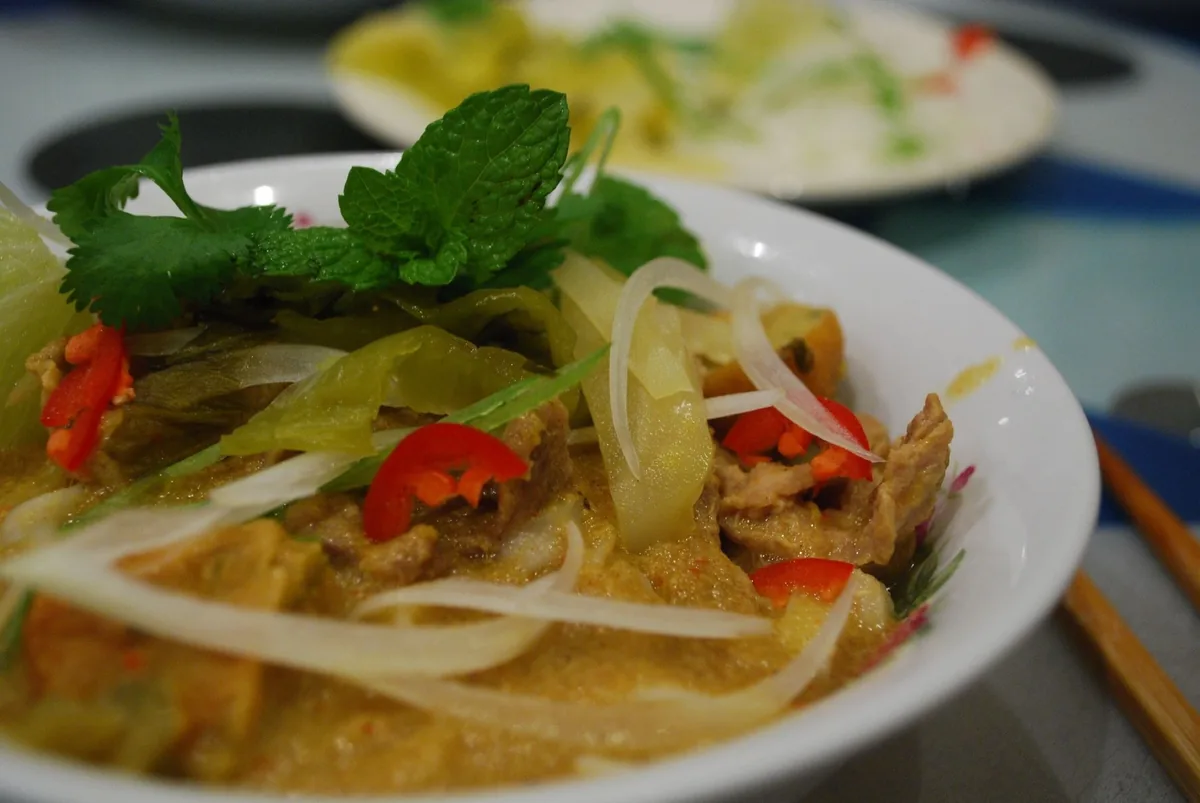 Khao soi in Chiang Mai
Cambodia and Laos
Cambodia and Laos: the two kitchens people skip
Khmer food is quieter than Thai food and closer to Vietnamese in its restraint. The backbone is kroeung, a paste of lemongrass, galangal, turmeric and kaffir lime, and prahok, fermented fish, which does the work that fish sauce does elsewhere. Amok trey, fish steamed in banana leaf with kroeung and coconut, is the national dish and is worth eating somewhere that makes it properly rather than in a buffet. Num banh chok, rice noodles under a green fish gravy, is a breakfast sold from baskets in the morning and gone by ten. Kampot pepper, which grows on the southern coast, is the one ingredient worth carrying home.
Lao food is the least known of the six and the most distinctive. Sticky rice is eaten by hand at every meal and is the measure of the whole cuisine. Laap here is the original — herbaceous, bitter, sometimes raw — and tam mak hoong, the Lao papaya salad, is saltier and funkier than its Thai cousin. Luang Prabang has its own dishes: or lam, a stew thickened with a numbing wood pepper, and kaipen, Mekong river weed dried in sheets and fried. The bitterness in Lao cooking is deliberate, and it takes a couple of meals to read.
Indonesia and the Philippines
Indonesia and the Philippines
Javanese food is sweeter than anything on the mainland, largely because of kecap manis and palm sugar. Yogyakarta’s own dish, gudeg, is young jackfruit stewed for hours until it is brown and sweet, eaten with egg and rice at breakfast. Around it sit satay, soto soups and the tempeh and tofu that Java does better than anywhere.
Balinese cooking is a different tradition again, and much of it is ceremonial rather than commercial — which is why a lot of visitors leave having eaten hotel food. Babi guling, spit-roasted suckling pig with a spice paste under the skin, is served at lunch and sells out; bebek betutu, duck slow-cooked in leaves, has to be ordered ahead; sate lilit is minced fish wrapped on lemongrass stalks; and sambal matah, raw shallot and lemongrass, is the thing you will want to make at home.
Filipino food is the outlier of the six: sour rather than hot, vinegar-forward, and shaped by Spanish and Chinese contact as much as by its neighbours. Adobo is meat braised in vinegar, soy and garlic, and varies by household. Sinigang is a sour tamarind broth. Kinilaw is raw fish cured in vinegar and calamansi, far better than the ceviche comparison suggests. Cebu is where to eat lechon.
Markets and classes
Markets, and what to do in one
A market at seven in the morning tells you more about a place than a museum does at ten. These are the ones we send people to, ideally with a guide for the first hour so that the unfamiliar things get named.
- Dong Xuan and the lanes around it in Hanoi, for dry goods, and any of the morning street markets in the Old Quarter for produce.
- Ben Thanh in Ho Chi Minh City is for souvenirs now; Binh Tay in Cholon is the working one.
- Warorot in Chiang Mai, for northern sausage, dried chilli and snacks, and Or Tor Kor in Bangkok for the best produce in the country.
- The Russian Market in Phnom Penh for food stalls at the back, and Siem Reap’s Psar Leu for the version without visitors.
- Luang Prabang’s morning market, which runs along one street and is finished by nine.
- Beringharjo in Yogyakarta for batik and street food, and Ubud’s produce market before seven.
- Carbon Market in Cebu, early, for mangoes and dried fish.
A cooking class is the other half of this. The good ones start at the market, take an hour over the shopping, and teach three or four dishes you would actually cook again. Hoi An, Chiang Mai, Luang Prabang, Siem Reap and Ubud all have classes we use regularly, and one per country is about right.
Practical
Eating street food without paying for it later
The advice to avoid street food is bad advice. Most of the best eating here happens on a pavement, and a stall that has fed the same office block for twenty years has a stronger interest in your health than a hotel buffet does. What matters is not where the food is cooked but how fast it moves and how hot it arrives.
- Eat where there is a queue of locals. High turnover means nothing has been sitting.
- Take food that is cooked in front of you and served straight from heat — grills, woks, noodle pots.
- Be more careful with things that stand at room temperature: pre-cut fruit on a tray, cold buffet dishes, cooked food left out under a cloth.
- Raw shellfish and raw river fish are the two categories worth simply skipping, particularly in the wet season.
- Commercially made tube ice, the cylinder with a hole through it, is made from treated water and is used everywhere. Crushed ice of unknown origin in a remote place is the one to wave away.
- Carry hand gel and use it. More traveller stomach upsets come from hands than from kitchens.
- Give yourself two or three days before the hottest, most fermented things. Prahok and padaek are worth eating; they are not worth eating on day one.
Build the trip around the eating.
Plan My Trip
A market morning in each country
Tell us you want a food-led route and we will put a class in each country, book the dinners worth booking, and leave the rest of the eating to you.
Common questions
Questions travellers ask most
Is street food safe?
Generally yes, and it is where most of the best food is. Choose stalls with a queue and high turnover, take what is cooked in front of you and served hot, and be more cautious with pre-cut fruit, cold buffets and raw shellfish than with anything coming off a grill.
Can I drink the ice?
Commercial tube ice — the cylinders with a hole through the middle — is made from treated water and is used in restaurants and stalls throughout the region. Crushed ice of unknown origin in a remote village is the one to decline.
How many cooking classes should I do?
One per country, at most. The good ones start at the market and teach three or four dishes properly. Hoi An, Chiang Mai, Luang Prabang, Siem Reap and Ubud are the places we use most.
I do not eat chilli. Will I struggle?
No. Northern Vietnamese, Khmer and Javanese cooking are mild by default, and in Vietnam and Thailand the chilli usually arrives on the side rather than in the bowl. Isan and southern Thai food are the two to approach with warning.
Journey ideas
Where a private route could take you
Travel guide
When to go
Twelve months, six countries, and the route shape each one suits.
View journey
Destinations
Vietnam
Three regions, three climates, and the border gates that make a two-country trip work.
View journey
Destinations
Thailand
Two coasts, four Mekong bridges, and one closed border that changes every route.
View journey
Travel guide
With children
Travel-day limits, what we refuse, and which countries are easiest with young children.
View journey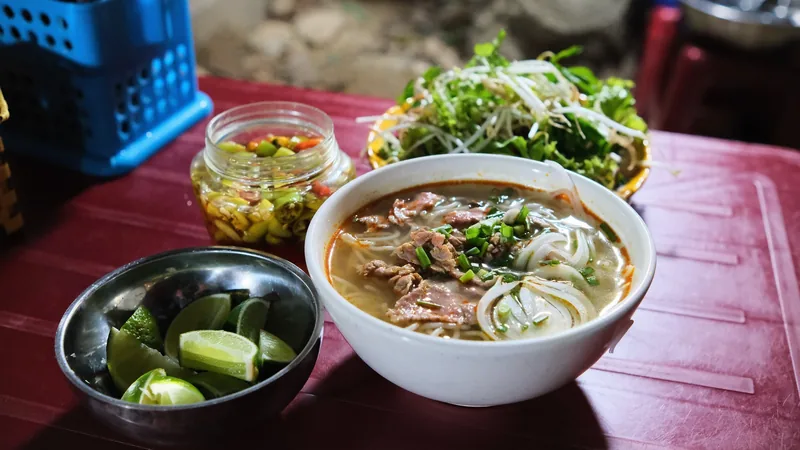
Start planning
Let’s plan your journey
Five quick questions. Your coordinator will take it from there.
Prefer to talk? WhatsApp or call+84 904 511 319