Multi-country
Cambodia and Laos in twelve days
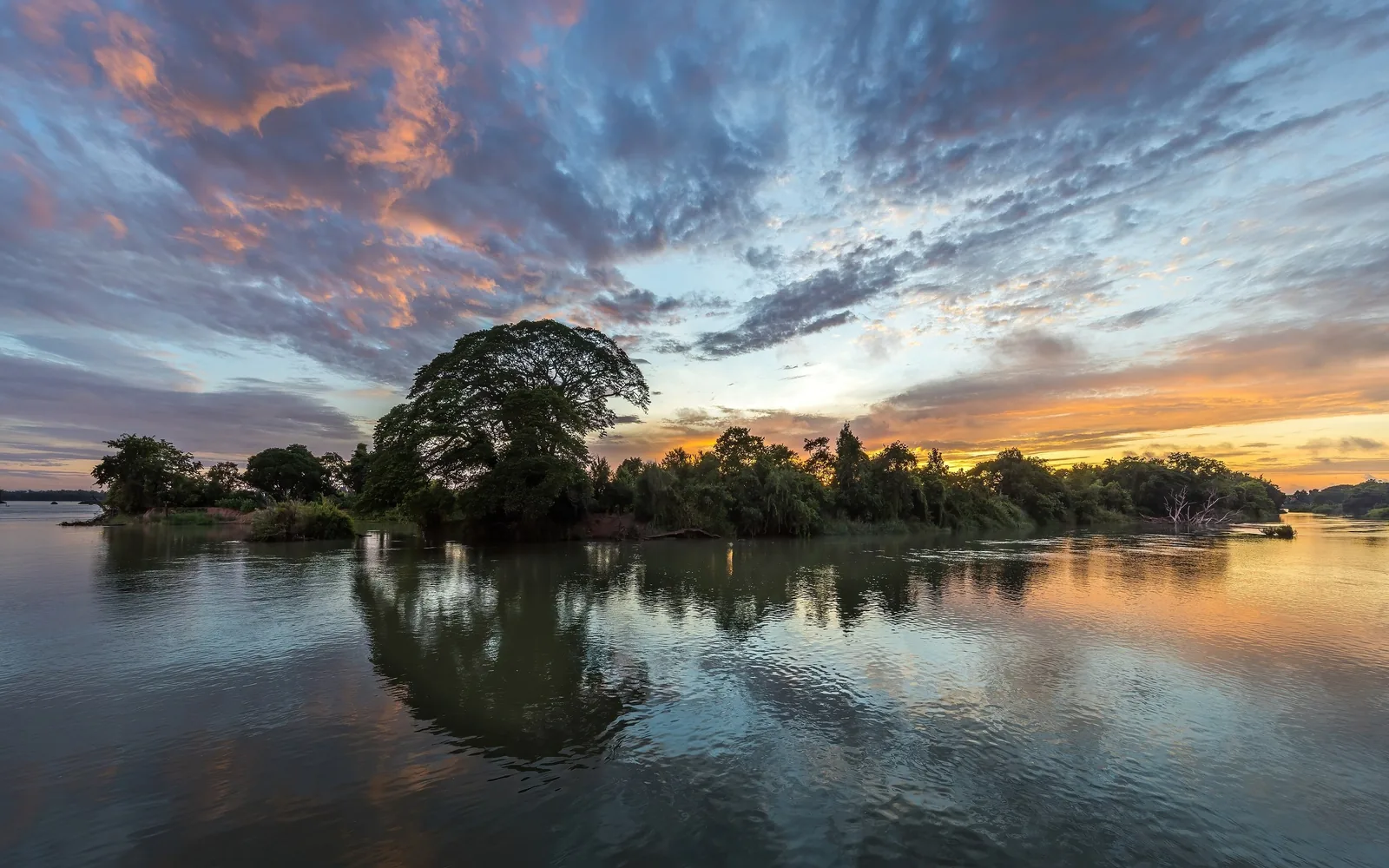
The only land link between these two countries is a single gate in the far north of Cambodia, and this route is built around it — following the Mekong upstream from Angkor to the widest water in Asia.
The route
One river, two countries, almost no traffic
Cambodia and Laos share about five hundred kilometres of border and exactly one crossing a visitor can use: Nong Nok Khiene on the Lao side, Trapeang Kriel on the Cambodian. It is a quiet gate in thin country, two hours north of Kratie and forty kilometres south of the 4000 Islands, and it is the reason this itinerary exists in the shape it does.
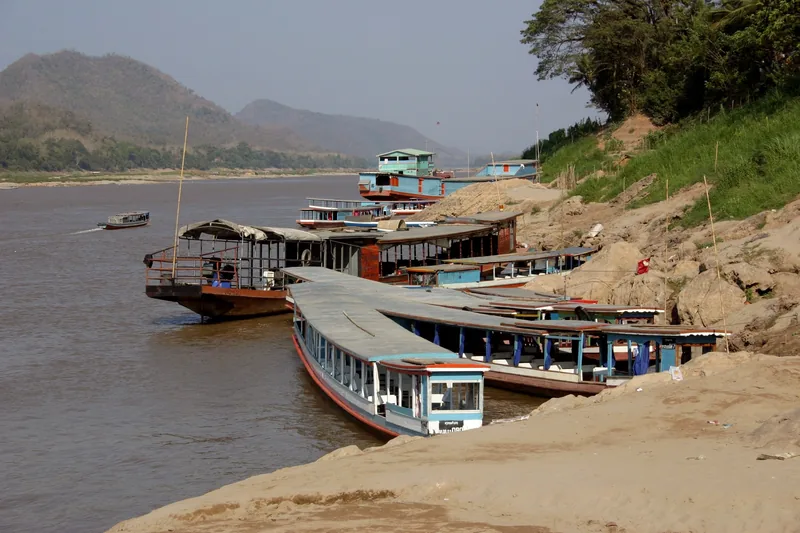
The route follows the Mekong the whole way. Angkor first, then Phnom Penh where the Tonle Sap meets the main river, then north to Kratie, over the border, and out onto Si Phan Don — the stretch where the Mekong spreads to fourteen kilometres wide and breaks into hundreds of islands. Wat Phou and Pakse follow, and a flight north finishes it in Luang Prabang.
- Length
- 12 days, 11 nights
- Group
- Private, up to 12
- Starts
- Siem Reap
- Ends
- Luang Prabang
- Borders
- One, by road at Trapeang Kriel
- Best months
- November to February
Stops
Where you stop
Itinerary
Day by day
Day 1
Arrive in Siem Reap
The new airport sits well east of town, so the transfer is about an hour rather than the fifteen minutes the older guidebooks describe. Nothing is scheduled. An early night is the sensible plan, because the first temple morning starts at half past five.
Day 2
Angkor, in the right order
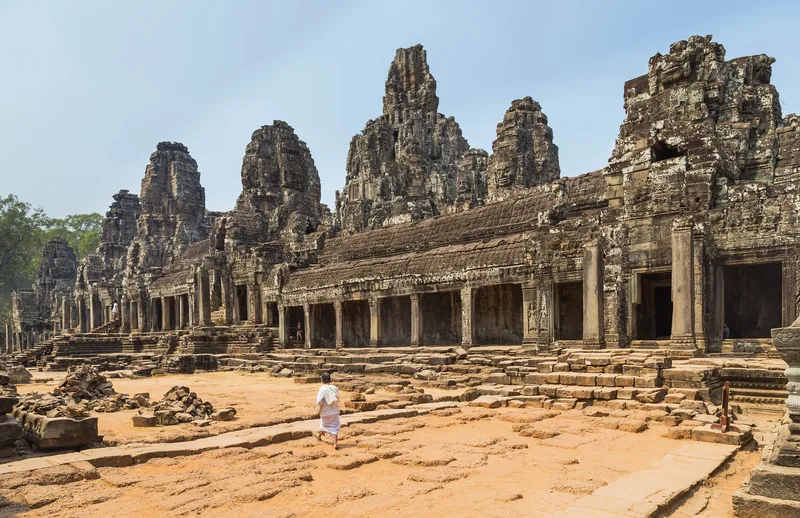
The Bayon before eight
Angkor Thom before Angkor Wat. The Bayon’s faces are best in the first two hours of daylight and the walled city absorbs a crowd better than anywhere else in the park. Then Ta Prohm for forty minutes, early. The middle of the day is off — it is genuinely unpleasant on open stone by eleven. Angkor Wat late in the afternoon from the west, which is the direction it was built to be approached from.
Day 3
Banteay Srei, and the lake or another temple
The carved lintels at Banteay Srei at seven in the morning
Banteay Srei is thirty-seven kilometres out and carved more finely than anything else in Cambodia; go at opening, when the pink sandstone is still cool. Preah Khan and Neak Pean on the way back are quiet at midday. If three temple days is one too many, we take the afternoon to Kampong Phluk on the Tonle Sap instead, and we will tell you honestly which boat operations there we will and will not use.
Day 4
South to Phnom Penh
Five and a half to six hours by road, flat and straight, or forty-five minutes by air. We fly it unless you want Battambang, which breaks the drive at three hours and is the best hour and a half of street architecture in the country — say so and we will add the night. The afternoon in Phnom Penh is the riverfront and nothing harder.
Day 5
Phnom Penh, and the two hours that are difficult
The seventh-century Khmer statuary at the National Museum
Tuol Sleng and Choeung Ek in the morning, in that order, with a guide who will not perform them. Four hours together, and they are the reason to stop in this city rather than fly over it. The afternoon is lighter: the Royal Palace and the silver pagoda, then the National Museum, which holds the pre-Angkorian and Angkorian sculpture that is not at Angkor.
Day 6
Up the river to Kratie
The dolphin pool at Kampi in the last hour of light
Five to six hours north along the Mekong, through rubber country and small river towns. Kratie is a single row of French shophouses facing the water with almost nothing to do in it, which is the point after Phnom Penh. Late in the afternoon a small boat goes out from Kampi, fifteen kilometres upstream, to a deep pool where the last Irrawaddy dolphins in the river live. There are very few of them and no guarantee; the boat keeps its distance and its engine off.
Day 7
Over the border at Trapeang Kriel, and out to the islands
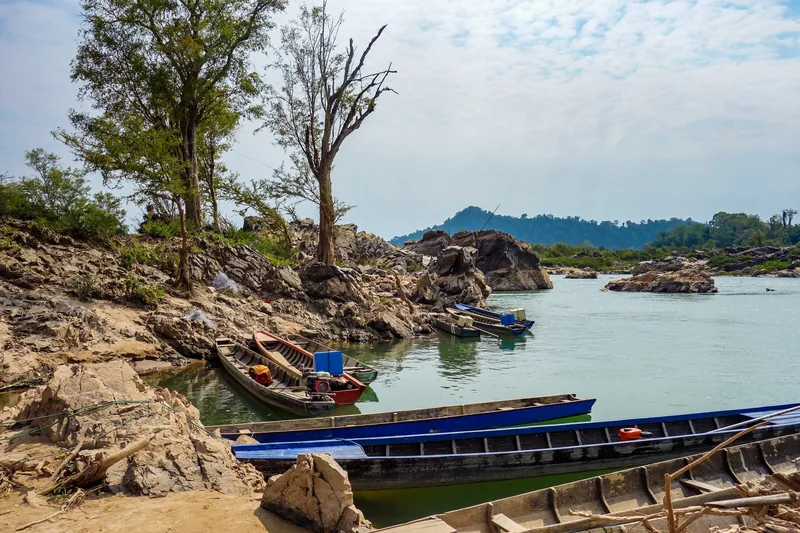
Coming out onto the islands by boat in the late afternoon
The border day. Three hours north to Stung Treng, then about an hour more to the gate. You clear Cambodian exit control at Trapeang Kriel, walk across, and clear Lao entry at Nong Nok Khiene — and here the asymmetry matters: the Lao e-visa is NOT valid at this gate, so you take a visa on arrival, in US dollars cash with a passport photograph. Allow 45 minutes to an hour and a half; this is a quiet crossing and the queue is usually short. A Lao vehicle meets you and Si Phan Don is about an hour further, with a boat at the end of it.
Day 8
Si Phan Don
Khone Phapheng in the morning, when the spray still catches the light
Fourteen kilometres of river, hundreds of islands, and two waterfalls that could not be less alike. Li Phi, beside Don Khon, is a chaos of channels rather than a single drop. Khone Phapheng, on the mainland bank, carries more water than any other fall in Southeast Asia and is the reason no boat has ever been able to run the Mekong from the sea to China. Between them is the French railway bridge, built to portage cargo around the falls and now the road between two islands. We do not sell dolphin trips on this side: the Lao pool is effectively empty and saying otherwise would be dishonest.
Day 9
North to Pakse, by way of Wat Phou
The view back over the plain from the top of Wat Phou
Three hours north along the river, stopping at Champasak for Wat Phou. The sanctuary climbs six terraces up a hillside below a spring and a mountain the Khmer took for a lingam, and the earliest stonework here is seventh century — older than anything at Angkor. Start early enough and the upper terrace is yours, with the Mekong plain laid out below. Pakse by late afternoon.
Day 10
North to Luang Prabang
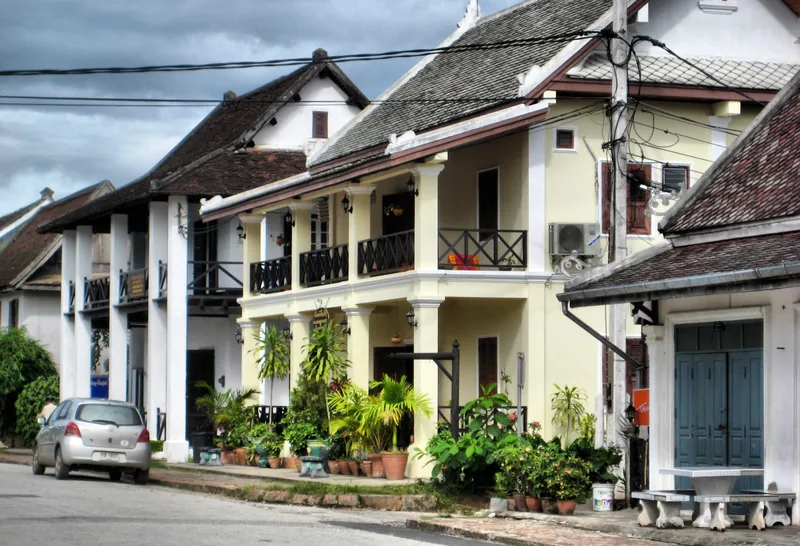
A flight north — direct when Lao Airlines schedules it, otherwise connecting in Vientiane, which costs the middle of the day either way. We keep the afternoon free rather than promise it. Luang Prabang in the late afternoon is the town at its best: the peninsula between two rivers, low tiled roofs, and the light going off the Mekong.
Day 11
Luang Prabang and Kuang Si
The lower pools before the minibuses arrive
The royal palace museum and Wat Xieng Thong in the morning, whose roof reaches almost to the ground and is the best piece of architecture in the country. Kuang Si after that, twenty-nine kilometres out and about forty-five minutes, where limestone pools step down through the forest in a turquoise nobody believes in photographs. Swim in the lower ones. Back in town for the evening with nothing scheduled.
Day 12
Luang Prabang, and home
The airport is fifteen minutes away. The morning market before seven is the last genuinely local thing on this itinerary and it is worth getting up for.
Borders
The border, in detail
Nong Nok Khiene – Trapeang Kriel is the only land link between Cambodia and Laos, and the documents work differently in each direction. Going north, as you do here, is the awkward way round.
- Cambodian exit control at Trapeang Kriel, on foot with your luggage. Quiet — there is very little traffic through this gate.
- Lao entry at Nong Nok Khiene. The Lao e-visa is NOT valid here. You take a visa on arrival: US dollars in cash, one passport photograph, filled in at the window. If you have already bought an e-visa it is wasted.
- Going the other way — Laos into Cambodia — the Cambodian e-visa IS accepted at Trapeang Kriel, which is one of only two Cambodian land gates where that is true. The asymmetry is the single fact to get right about this crossing.
- The Lao digital immigration form is filed within three days of arrival and again before departure.
- Neither government publishes a live status page for this gate, so we confirm it with operators on both sides before every departure.
We do not publish visa fees. The current figures are on the Cambodian and Lao government portals, and your coordinator confirms them in writing before you travel — including how many US dollars in cash to carry to the window at Nong Nok Khiene, and in what denominations. There is no card machine at this border and no cashpoint you should rely on.
Photographs
What the days look like
Angkor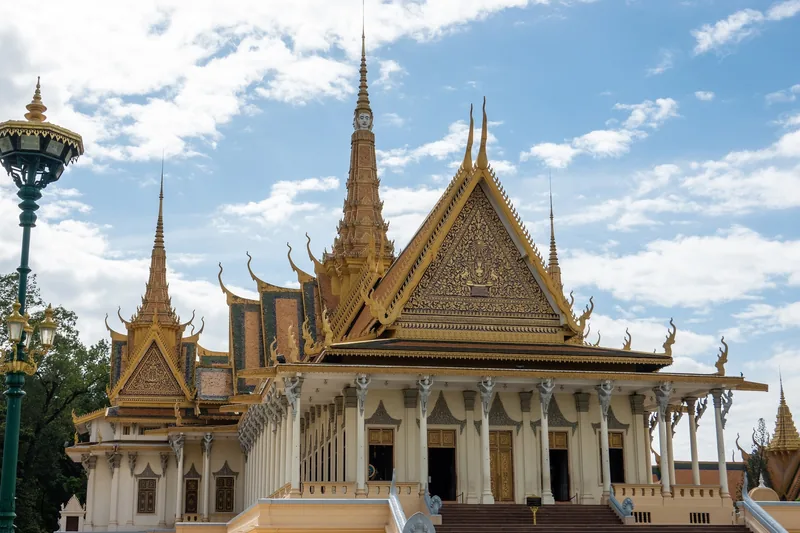 Phnom Penh
 Kratie
 Trapeang KrielSi Phan Don
 Luang Prabang
Price
What it costs
| Travellers | Comfortable hotels | Boutique and luxury |
|---|---|---|
| 2 travellers | On request | On request |
| 4 – 6 travellers | On request | On request |
Kratie and Si Phan Don have no luxury standard at all, and three of these eleven nights are simple whichever column you choose. The difference between the two is made at Siem Reap, Phnom Penh and Luang Prabang, where it is substantial.
Included
What is included
What the price includes
- Private air-conditioned car and driver in Cambodia, and a separate Lao vehicle from Nong Nok Khiene onwards.
- English-speaking local guides: one in Cambodia, one in Laos, each licensed in their own country and changing at the border.
- Internal flights as listed — Phnom Penh to Siem Reap if you choose to fly rather than drive on day four, and Pakse to Luang Prabang, direct or via Vientiane — in economy with checked baggage.
- Eleven nights of accommodation with breakfast, including two simple island nights at Si Phan Don and one river-town night at Kratie.
- Lunch on the first Angkor day, the Kratie day, the border day and the Wat Phou day.
- Entrance fees to everything named in the day-by-day: the three-day Angkor pass, Banteay Srei, Tuol Sleng, Choeung Ek, the Royal Palace, the National Museum, Khone Phapheng, Li Phi, Wat Phou, the Luang Prabang royal palace museum and Kuang Si.
- Boat trips: the dolphin boat at Kampi with the engine off, the crossing out to Si Phan Don and back, and a Mekong crossing at Champasak.
- All airport and border transfers, including the vehicle handover at the gate.
- A coordinator on a local number for the whole trip, and a written note of which document each country needs, in what form, and how much cash to carry to the Lao window.
What it does not include
- International flights into the first city and out of the last.
- Visa fees for every country on the route. We do not publish these figures — the current ones are on each government’s official portal, and your coordinator confirms them in writing before you travel.
- Travel insurance, which we ask every traveller to hold.
- Meals not named in the day-by-day, and all drinks.
- Tips for guides, drivers and boat crew.
- Personal expenses: laundry, telephone, spa treatments, anything bought.
Honesty
Who this route is not for
This is a thin-country itinerary for most of its middle, and we would rather say so now.
- Anyone who needs a good hotel every night. Kratie and the 4000 Islands have clean, plain guesthouses and nothing above them. Three nights out of eleven are simple and no budget changes that.
- Travellers who will not do long road days. Day six is five to six hours, day seven is six to seven with a border and a boat in it, and neither can be shortened without cutting the route in half.
- Anyone who came to see Irrawaddy dolphins. There are very few left at Kampi and none worth selling on the Lao side. We will take you out with the engine off and we will not promise you an animal.
- Travellers with a wheelchair or serious mobility limits. The border is crossed on foot with luggage, the island boats are boarded off a bank, and Angkor and Wat Phou are both uneven stone with steep stairs.
- Anyone travelling in March, April or May. It is the hottest stretch of the year in both countries, Angkor is punishing by eleven, and the Bolaven-side haze reaches this far south.
Upstream, from Angkor to the widest water in Asia.
Plan My Trip
Start from this route
Tell us your dates. We confirm the Trapeang Kriel gate with operators on both sides before we quote it.
Common questions
Questions travellers ask most
Does the Lao e-visa work at this border?
No. Entering Laos at Nong Nok Khiene you take a visa on arrival, in US dollars cash with a passport photograph, and an e-visa bought in advance is wasted. Going the other way, the Cambodian e-visa is accepted at Trapeang Kriel — the rule is not symmetrical and this is the most common mistake on this route.
Could we skip Kratie and do the border in one day?
Phnom Penh to Si Phan Don in a single day is eleven or twelve hours including the border, and we will not build it. Kratie splits it into two manageable days and adds the only stretch of the Cambodian Mekong most visitors ever see.
Is three days at Angkor too many?
Not at this pace. The three-day pass is included and valid on any three days within ten, and the reason for three is that it lets you stop between six and ten in the morning and again after four, which is when the temples are worth being in. If you would rather have two, we will give the day to the lake or to Battambang.
Can we run it the other way, Luang Prabang to Angkor?
Yes, and the paperwork is easier that way: the Cambodian e-visa is accepted at Trapeang Kriel, so you arrive in Laos by air with an e-visa and leave by land with one too. The trade is that the river then runs against you the whole trip, which matters less than it sounds.
Journey ideas
Where a private route could take you
Example itinerary — fully customizable
Thailand & Laos
Nine days, one bridge, and two days on the river to Luang Prabang.
View journey
Example itinerary — fully customizable
Indochina, 21 days
Twenty-one days, three countries, two land crossings and one flight.
View journey
Laos
Pakse
Three nights in the south, and the only overland link to Cambodia.
View journey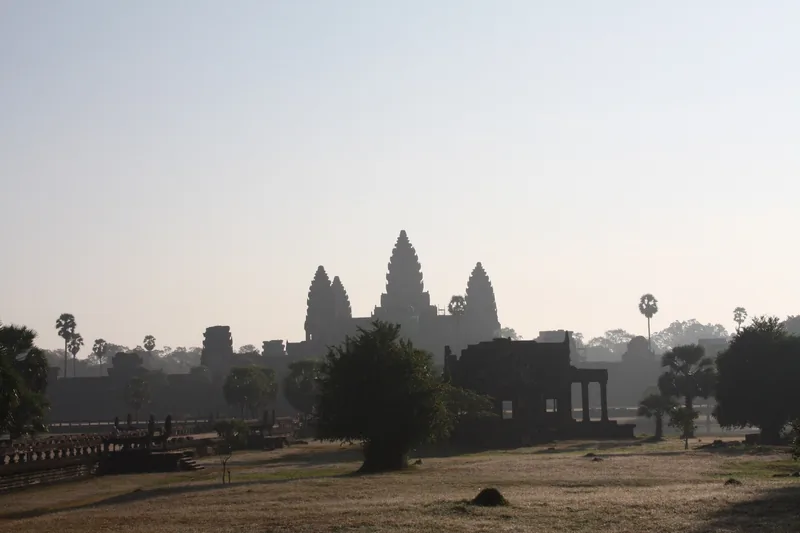
Cambodia
Siem Reap
Three or four mornings at Angkor, and the town you sleep in between them.
View journey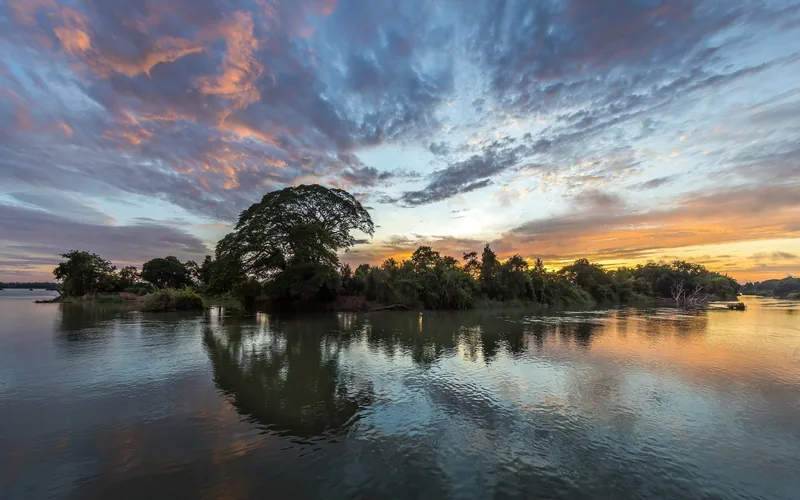
Start planning
Let’s plan your journey
Five quick questions. Your coordinator will take it from there.
Prefer to talk? WhatsApp or call+84 904 511 319