
Travel guide
How many days each country needs
Four countries in fourteen days is really eight days of travelling and six days of being somewhere. This is the arithmetic we do before we propose a route, written out.
Planning
The arithmetic almost nobody does
A fortnight sounds like a lot until you write it down properly. Fourteen days from a European city means a night in the air on the way out and a day lost to arrival, so you have thirteen usable days. Take a country you have never been to and you will want two nights in the first city simply to stop feeling ill. Add a second country and you spend a day crossing; add a third and you spend another. By the time four countries are in the plan, six of your thirteen days are movement and the remaining seven are split four ways.
That is the arithmetic behind the sentence we say most often on the phone: three countries in a fortnight is the honest ceiling, two is better, and four is a slideshow. It is not a sales position. A route with fewer joins costs us less to run and usually costs you less to buy.
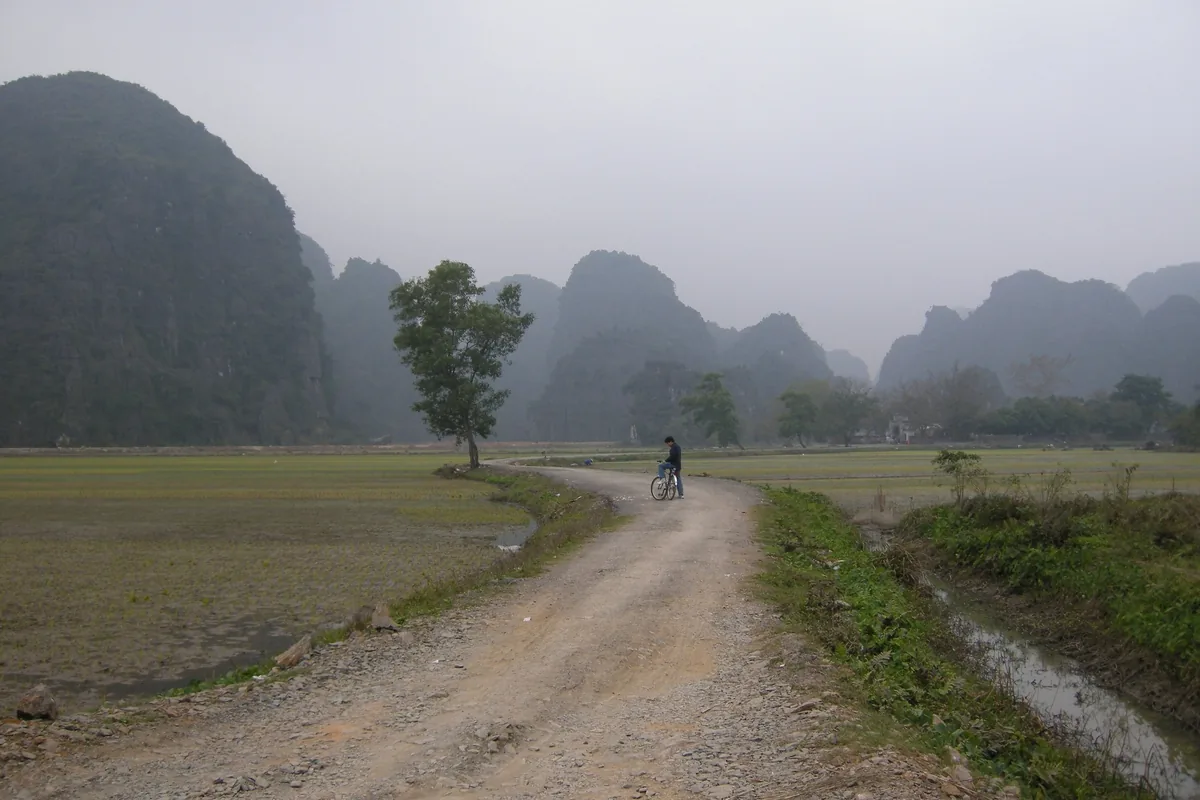 The road south from Hanoi
Minimums
Realistic minimum nights, by country
These are minimums for a trip that is worth taking, not the shortest technically possible visit. Below them you are collecting stamps.
| Country | Bare minimum | What that covers | Comfortable |
|---|---|---|---|
| Vietnam | 7 nights | One half of the country — north or south, not both | 12 – 14 nights |
| Thailand | 5 nights | Bangkok and one other place, north or beach | 9 – 12 nights |
| Cambodia | 4 nights | Siem Reap and Angkor alone | 6 – 8 nights |
| Laos | 4 nights | Luang Prabang and Kuang Si, nothing else | 7 – 9 nights |
| Indonesia | 6 nights | Bali only, inland and coast | 10 – 12 nights |
| Philippines | 6 nights | One island group, with its internal flights | 10 – 12 nights |
Two of those deserve a word. Cambodia at four nights means three temple mornings and a day on the water, which is genuinely enough to understand Angkor; it is Phnom Penh and everything south of it that gets cut. Indonesia and the Philippines carry higher minimums than their land areas suggest because both are archipelagos: an internal flight and a boat transfer stand between most pairs of good places, and neither can be done at the end of a long day.
Borders
What a border day actually costs you
A land crossing is rarely the two hours it looks like on a map. Moc Bai, between Ho Chi Minh City and Phnom Penh, is the smoothest road border in the region and still takes six to seven hours door to door. Lao Bao, from Hue into Savannakhet, is seven to eight. Tay Trang, from Dien Bien Phu, is five. Those are driving days: you leave after breakfast, you arrive in time for dinner, and you have seen a border post and a lot of agricultural country.
The cost is not only the hours. A crossing day cannot absorb anything else — no morning excursion, no afternoon arrival activity — so it takes a full slot out of thirteen. It puts both hotel nights at risk if the paperwork is wrong. And it usually forces a hotel change on either side, which is another hour packing and another hour unpacking.
| Border | Crossing | Route | Time at the border | Status | What it means for your visa |
|---|---|---|---|---|---|
| Vietnam – Cambodia | Moc Bai – Bavet | Road, Ho Chi Minh City – Phnom Penh | 6 – 7 h | Open | Cambodian e-visa accepted here. Your Vietnamese e-visa must name Moc Bai as the exit gate. |
| Vietnam – Cambodia | Ha Tien – Prek Chak | Road, Phu Quoc ferry – Kampot / Kep | 3 h from Ha Tien to Kampot | Open | Take a Cambodian visa on arrival here (USD cash and a passport photo). The e-visa is not listed for this gate. |
| Laos – Cambodia | Nong Nok Khiene – Trapeang Kriel | Road, 4000 Islands – Stung Treng | 2 h | Operating, no government status page | Cambodian e-visa accepted at Trapeang Kriel; leaving Laos needs no e-visa, but entering Laos this way does need a visa on arrival. |
| Thailand – Cambodia | Aranyaprathet – Poipet | Road, Bangkok – Siem Reap | — | Closed since 23 June 2025 | Closed to tourists. Fly Bangkok – Siem Reap instead. |
| Thailand – Cambodia | Hat Lek – Cham Yeam | Road, Trat – Koh Kong | — | Closed since 23 June 2025 | Closed to tourists. |
Flying is not free either, but it is cheaper in days. Bangkok to Siem Reap is an hour in the air and about five hours door to door with the airport margins, which is still most of a day but leaves an evening intact. Our rule of thumb: take the land crossing when the crossing is part of what you came for — the Mekong slow boat, the delta road into Cambodia — and fly when it is only a transfer.
Border rules were verified against government sources on this date. Two matter for the day count: the Thailand – Cambodia land border has been closed to tourists since 23 June 2025 and remains closed, so Bangkok to Siem Reap is a one-hour flight and not a road day; and the Vietnamese e-visa fixes the entry and exit gates you named on the application, which cannot be changed afterwards. We do not print visa fees, because they change without announcement.
Worked example
Ten days: one country, or one and a half
Ten days from Europe gives you eight and a half on the ground. One country, done properly, is the only version of this that is not a rush.
- The shape that works
- Vietnam, north to south: Hanoi 2 nights, Ha Long Bay 1, Hoi An 3, Ho Chi Minh City and the delta 2, with two internal flights of about an hour and fifteen each.
- Why it works
- The only long movements are flown, no border is crossed, and the three-night stop in the middle gives you a day with nothing booked in it.
- The variant
- Thailand instead: Bangkok 3, Chiang Mai 3, an Andaman beach 3. Same principle, one internal flight.
- What to refuse
- Vietnam and Cambodia in ten days with the land border in the middle. It fits on paper and delivers one full day in Phnom Penh.
If you must have two countries in ten days, make the second one Cambodia and fly into Siem Reap: four nights at Angkor and five in southern Vietnam is a real trip, because the join is an hour rather than a day.
Worked example
Fourteen days: two countries, one border
This is the length most of our multi-country trips are built at, and the shape is almost always the same: eight or nine days in the larger country, four or five in the second, and one crossing placed in the middle of the trip rather than at the end.
The version we argue against at this length is four countries — Thailand, Laos, Cambodia and Vietnam in a fortnight. Two of the joins would have to be flown, the third is a closed border, and you would average two and a half nights per country including the nights you arrive after dark.


Worked example
Twenty-one days: three countries without hurrying
Three weeks is where a multi-country route stops being a compromise. Twenty days on the ground carries three countries at two to four nights per stop, two land borders or one border and one short flight, and — this is the part that matters — two or three days with nothing scheduled.
- The shape that works
- Northern Vietnam 5, central Vietnam 4, southern Vietnam 3, Cambodia by road 5, Laos by air 3. Or the same run in reverse, starting in Luang Prabang.
- Where the slack goes
- One unbooked day in Hoi An, one in Siem Reap, and a spare afternoon at each border. That slack is what makes the difference between a trip you enjoy and a trip you complete.
- What three weeks does not buy
- All six countries. Indonesia and the Philippines are flights of four to six hours away from the mainland and belong in their own trip, or in a fourth week.
- The honest alternative
- Two countries in three weeks at four nights a stop, which is the version most people who have done a fortnight come back and ask for.
How we build a route
The rules we plan by
- Two nights anywhere is one full day. Three nights is two, and is the minimum for a place you actually want to see.
- A travel day is a whole day. Count it as one, not as a morning.
- One border per week is comfortable, two is the maximum, and every additional country needs three nights or it should not be in the route.
- Put the crossings early and the flights home late. Slack belongs at the end of a trip, not the start.
- When the maths does not work, remove a country before you remove nights from the ones you have kept.
Send us your dates and we will do the arithmetic.
Plan My Trip
How far does your fortnight actually go?
Tell us the days you have and the countries you want. We will show you what fits and what we would leave out.
Common questions
Questions travellers ask most
Can I see four countries in two weeks?
You can enter four countries in two weeks. You will not see them: after the joins you are left with about two and a half nights each, and two of those arrivals will be after dark. We would plan two countries at that length, or three at three weeks.
Is it faster to fly or to cross by land?
Almost always faster to fly, and the difference is a day rather than an hour. Take the land route when the crossing is something you want to do — the Mekong slow boat, the delta road into Cambodia — and fly when it is purely a transfer.
How many nights does Angkor need?
Three mornings, on a three-day pass, which means four nights in Siem Reap. Two mornings covers the main circuit and misses the outlying temples, which are the ones people describe afterwards.
What is the shortest trip worth taking to the region?
About ten days from Europe, which is eight and a half on the ground and enough for one country done properly. Under that, a single-city stopover of three or four nights is more satisfying than a country tour compressed to fit.
Journey ideas
Where a private route could take you
Travel guide
Two-week routes
Five fourteen-day shapes, with the joins that make them possible.
View journey
Travel guide
When to go
Twelve months, six countries, and the route shape each one suits.
View journey
Example itinerary — fully customizable
Vietnam & Cambodia
Fourteen days, two countries, one land border — Hanoi to Angkor.
View journey
Example itinerary — fully customizable
Indochina, 21 days
Twenty-one days, three countries, two land crossings and one flight.
View journey
Start planning
Let’s plan your journey
Five quick questions. Your coordinator will take it from there.
Prefer to talk? WhatsApp or call+84 904 511 319