
Laos
Laos in eight days, by river and rail
Two days on a wooden boat, three in the old royal capital, and a railway that turned a seven-hour mountain road into two hours — the whole country without an internal flight.
Overview
Arriving by river, which is the point
You can fly Chiang Mai to Luang Prabang in an hour. Almost everybody does, and it is the single most avoidable mistake in a Lao itinerary. The alternative is two days on a wooden boat down the Mekong with a night at Pak Beng, and it is the one border crossing in the region that travellers look forward to rather than endure. The river is the road here; villages are on it, cargo moves on it, and you arrive at Luang Prabang from the water, which is how the town was meant to be reached.
The second half of the week uses the Laos–China railway, which has changed Lao travel more than anything in a decade. Vientiane, Vang Vieng and Luang Prabang are now about two hours apart by train instead of six or seven by mountain road, and that is what makes a country this size workable in eight days without boarding an aircraft.

- Length
- 8 days, 7 nights
- Group
- Private, up to 12
- Starts
- Huay Xai, at Friendship Bridge IV
- Ends
- Vientiane
- Internal flights
- None
- Best months
- November to February
Nights
The nights, in order
Day by day
What happens each day
Day 1
Over the bridge at Chiang Khong
Standing on the Lao bank with two river days ahead
You are collected in Chiang Rai — an hour and a half from the bridge, or three hours further if you start in Chiang Mai — and driven to Chiang Khong. The Fourth Thai–Lao Friendship Bridge is crossed by shuttle bus, about thirty minutes with formalities, because walking it is not permitted. Your Lao guide meets you on the far bank at Huay Xai. The night here exists so that tomorrow starts with breakfast rather than an alarm at four.
Day 2
Down the Mekong to Pak Beng
The middle of the afternoon, when you stop checking how far there is to go
Boarding in the morning for the first of two long river days — roughly six to seven hours depending on the water, on a wooden boat with bench and car seats, an engine you get used to, and no schedule to keep. The banks are forest, sand bars, buffalo and villages reached only from the water, and the boat stops where someone needs it to. We use a private or small-group boat rather than the packed public service, and we do not use the fast boat at all.
Day 3
The second river day, and arriving at Luang Prabang
The first sight of the peninsula from the water
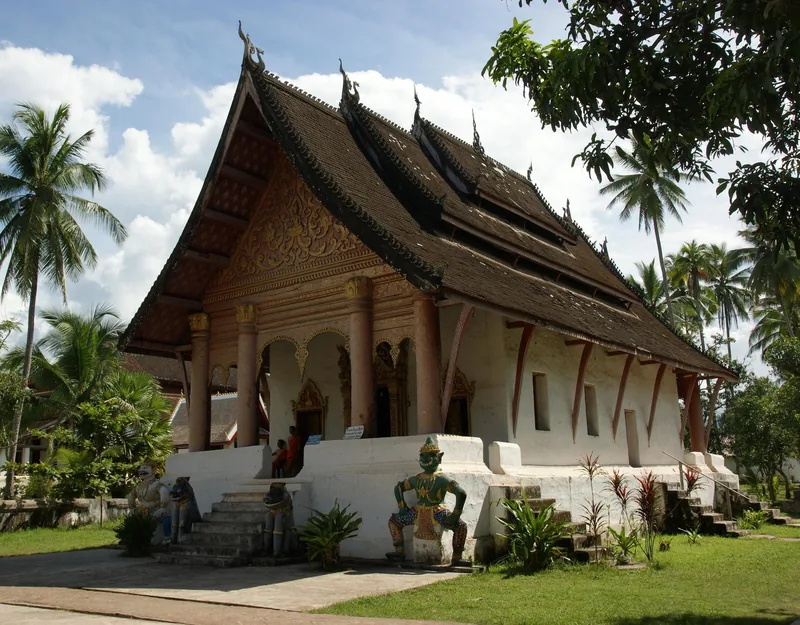
Another six to seven hours, with a stop at the Pak Ou caves near the end — two river caverns packed with thousands of small Buddha figures left by pilgrims over four centuries. You reach Luang Prabang in the late afternoon and step off onto the bank below the old town, which is a considerably better arrival than a runway.
Day 4
The alms round, the temples, and the hill
Wat Xieng Thong, the one temple we would insist on
Shortly after five, several hundred monks leave the monasteries in single file to collect rice from residents kneeling along the street. It is a daily observance, not a performance. Watch from across the road, stay out of the line, no flash, no camera in anybody’s face — and if you want to give rice, we arrange it the day before rather than buying it from a bucket on the pavement, which the monasteries have repeatedly asked people to stop doing. Afterwards: Wat Xieng Thong, two more temples of your choosing, and Mount Phousi early rather than at sunset, when it is a queue on a staircase.
Day 5
Kuang Si, and an afternoon off
The lower pools at Kuang Si before nine
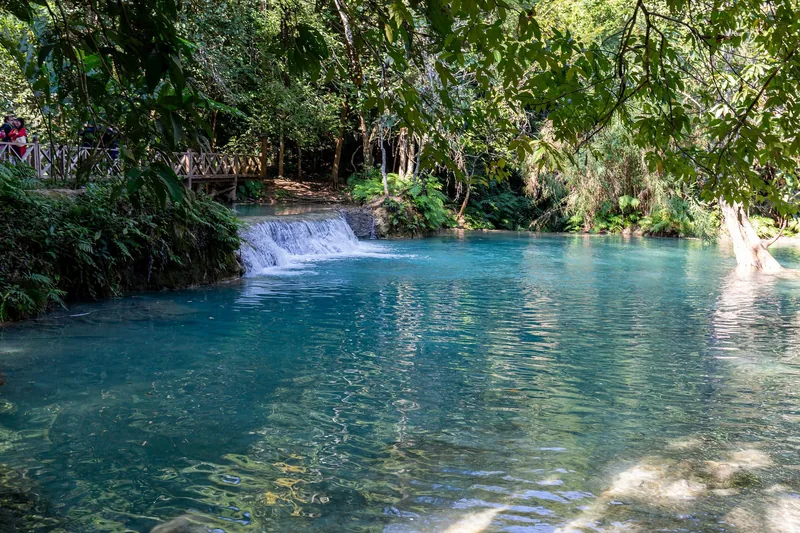
Twenty-nine kilometres out, about forty-five minutes, and the best half-day in northern Laos: limestone pools in a milky turquoise that nobody believes in photographs, stepping down through forest below the main fall. Go at eight, before the minibuses, and swim in the lower pools. The bear sanctuary at the entrance is a genuine rescue operation and worth the twenty minutes. The afternoon is free — a cooking class, a weaving village across the river, or nothing.
Day 6
South by rail to Vang Vieng
The towers from the valley floor, with cloud caught on the tops
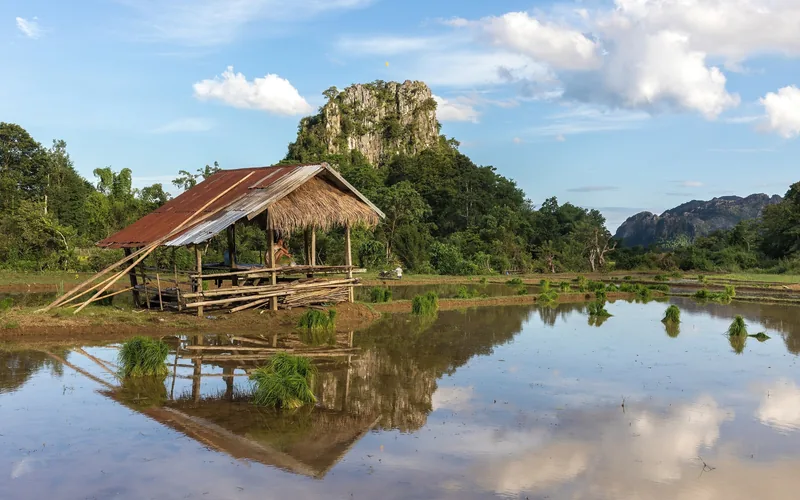
The station is some way out of town and the train takes about two hours through tunnels and river valleys — the same journey was six or seven hours of mountain road until recently. Vang Vieng sits in a flat valley with a wall of limestone towers three hundred metres high directly behind it. The afternoon is one cave or one lagoon, and the difference between a good afternoon and a crowded one is how far out you are willing to drive: the nearest lagoon is busy from ten, and the ones twenty to forty minutes down dirt roads are quiet all day.
Day 7
Dawn over the valley, then the capital
The valley from the air at six in the morning
In the dry season, a balloon or paramotor flight at first light — twenty minutes over the towers with mist still in the valley, and the best thing in the town by a distance. Otherwise a viewpoint climb, forty minutes of steep loose rock, before eight. Then the train south, about two hours, and an afternoon in Vientiane: Pha That Luang late in the day when the gold turns orange, and an hour on the riverfront, which fills for two hours each evening and then empties.
Day 8
COPE, and out
An hour at COPE, which we send everybody to
Wat Si Saket first, the oldest surviving temple in the city and the only one the Siamese army left standing in 1828, with thousands of small Buddha images in niches along its cloister. Then COPE, attached to the national rehabilitation centre, which explains what happened here between 1964 and 1973 and what is still happening because of it: more than two million tonnes of ordnance dropped, a large share of it unexploded and still in the ground. It is free, it takes an hour, and it is the most important thing in the city. Wattay airport is fifteen minutes away.
Paperwork
The Lao e-visa, and the nine ports it works at
Laos has the most particular entry rules of the six countries and the ones most often got wrong, because the e-visa is valid only at named ports and this route uses one of them on purpose.
- Of the passports we most often book, only Japanese travellers have 30 days visa-free. British, EU, American, Australian and Canadian passports all need a visa.
- The Lao e-visa is single entry, 30 days, and must be carried PRINTED — a phone screen is refused at the gate.
- It is valid at nine ports only: Wattay, Luang Prabang and Pakse airports, Friendship Bridges I, II and IV, the Boten checkpoint, and Boten and Khamsavath railway stations.
- This route enters at Friendship Bridge IV, Chiang Khong to Huay Xai, which IS on that list. The e-visa works here, and the fee is not refunded if you arrive at a port it does not cover.
- The Lao digital immigration form is filed within three days of arrival and again before you leave. Passport valid six months, two blank pages.
- On the Thai side, the 30-day visa exemption in force since 15 September 2026 allows only two overland entries per calendar year, and the Thailand Digital Arrival Card is compulsory and free, filed within three days of arrival — including when you arrive by land.
We do not publish visa fees. The current figures are on the official Lao and Thai portals, and your coordinator confirms them in writing. The rule worth repeating: print the Lao e-visa before you leave home, because there is nowhere to do it at the bridge.
Pictures
What the eight days look like
 Huay XaiThe Mekong
 Pak BengLuang Prabang
 Kuang Si
 Vang Vieng
Cost
How we quote it
| Travellers | Comfortable hotels | Boutique and luxury |
|---|---|---|
| 2 travellers | On request | On request |
| 4 – 6 travellers | On request | On request |
Two of these seven nights are at Huay Xai and Pak Beng, which have basic rooms and nothing above them in either column — that is the honest cost of taking the river. Luang Prabang is where the columns separate, with several genuinely good small hotels in restored buildings. Ask and the figure comes back within a working day, itemised, with every room named.
Included
What the quote covers
What the price includes
- The road transfer from Chiang Rai or Chiang Mai to Chiang Khong, the bridge shuttle, and a Lao guide and vehicle waiting at Huay Xai.
- Two days on a private or small-group wooden slow boat with reserved seating, water and lunch aboard. We do not use the fast boat on this river and will not book it.
- English-speaking licensed Lao guides at Luang Prabang, Vang Vieng and Vientiane, and on both river days.
- Seven nights with breakfast: one at Huay Xai, one at Pak Beng, three in the Luang Prabang old town, one at Vang Vieng and one in Vientiane.
- Lunch on both river days and at Kuang Si.
- Both rail legs — Luang Prabang to Vang Vieng and Vang Vieng to Vientiane — booked several days ahead, with station transfers at each end, because seats sell out in the high season and there is no practical standby.
- Entrance fees to everything named above, including the Pak Ou caves, Wat Xieng Thong, Mount Phousi, Kuang Si with the bear sanctuary, the Vang Vieng cave or lagoon, Pha That Luang and Wat Si Saket.
- Rice arranged properly through the monastery if you wish to take part in the alms round, rather than bought from a pavement bucket.
- A coordinator on a Lao number for the whole trip, and a written note of the e-visa, the port it is valid at, and the reminder to print it.
What it does not include
- International flights into the first city and out of the last.
- Visa fees and entry charges. We do not publish these figures — the current ones are on the government’s official portal, and your coordinator confirms them in writing before you travel.
- Travel insurance, which we ask every traveller to hold.
- Meals not named in the day-by-day, and all drinks.
- Tips for guides, drivers and boat crew.
- Personal expenses: laundry, telephone, spa treatments, anything bought.
Straight talk
Who should not book this route
Two full days on a wooden boat is either the best part of the trip or the reason not to book it, and there is no middle position. Five travellers should take something else.
- Anyone who cannot sit still for six or seven hours. The boat has no internet, no cabin and nowhere to walk; the engine is loud and the seats are car seats bolted to a deck. Bring a book and it is one of the best days in the region. Expect entertainment and it is a very long afternoon.
- Anyone on a tight schedule. Flying Chiang Mai to Luang Prabang takes an hour and removes two days from this itinerary. If those two days are the constraint, fly — we will build the shorter version rather than argue.
- Travellers with a wheelchair or serious mobility limits. The boat is boarded from a riverbank by plank, Pak Beng is reached up a steep bank, the caves have steps cut in rock, and the alms round is watched from a pavement.
- Anyone travelling in March or April. Agricultural burning hazes the entire north for weeks — the towers at Vang Vieng disappear, the river valleys fill, and no planning works around it. We would rather move your dates than run the week then.
- Anyone expecting comfort at Huay Xai and Pak Beng. Both are stops rather than destinations and the rooms are plain in either column. The alternative is to fly into Luang Prabang, and then the river is not part of the trip at all.
Two days on the river, and no aircraft at all.
Plan My Trip
Start from this route
Tell us your dates and where you are coming from in Thailand. We will send a quote and an amended day-by-day within a working day.
Common questions
Questions travellers ask most
Can we take the fast boat instead?
We do not book it. The fast boats run the same stretch in a few hours at high speed on a river with rocks and submerged timber, with crash helmets issued, and the accident record is poor. If two days is too long, fly to Luang Prabang and we will rebuild the week around it.
What is Pak Beng like?
A single street on a steep bank, a row of guesthouses, a few restaurants and a generator. Everybody on the river stops there because there is nowhere else, and the point of the night is the early start the next morning. It is plain and it is fine.
Does the boat run in the rainy season?
Yes. The Mekong runs high and fast from June and the journey is often quicker, not slower. What the rains affect is visibility from the hills and the state of the roads at either end, not the boat itself.
Could we go the other way, Vientiane to the border?
You can, and the rail legs work equally well northbound. The river is better travelled downstream — the boats take longer against the current and the light through the afternoon is wrong. If the route has to run south to north, we would fly the river leg and keep the train.
Journey ideas
Where a private route could take you

Example itinerary — fully customizable
Southern Laos
Seven days around Pakse, ending where the Mekong falls apart.
View journey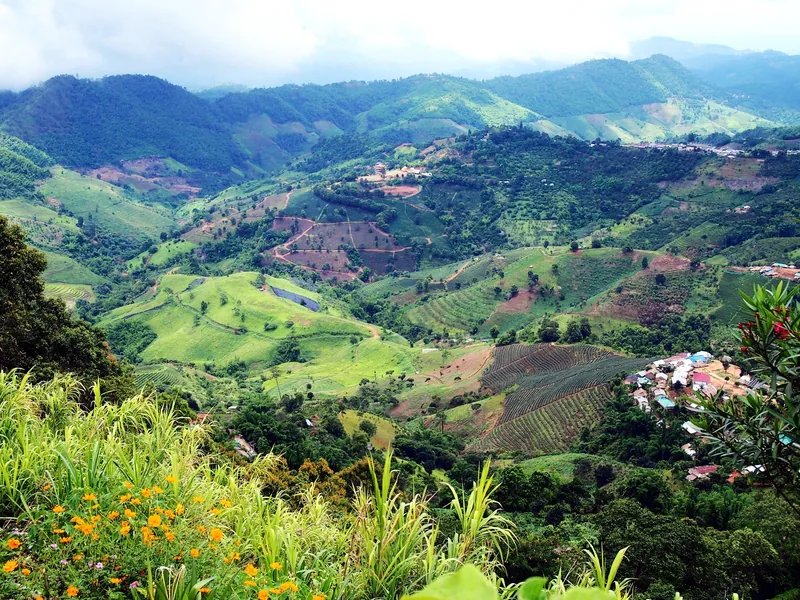
Example itinerary — fully customizable
Northern Thailand
Seven days in the hills, ending where three countries meet.
View journey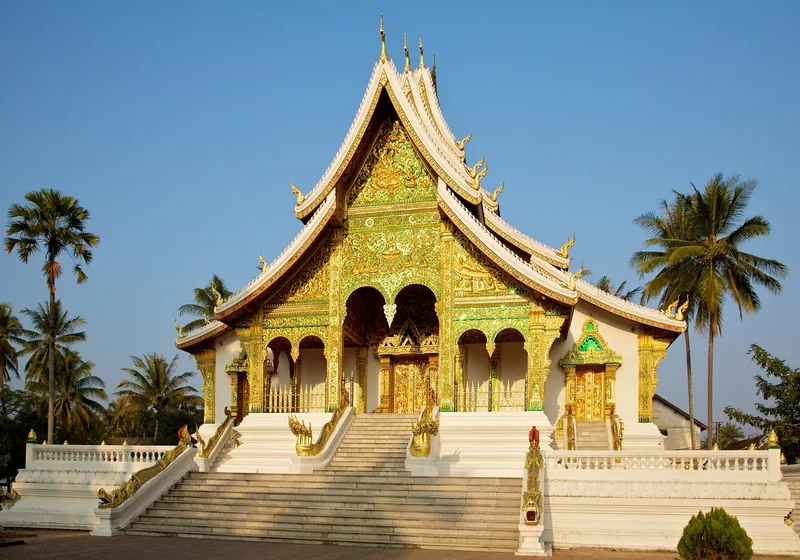
Laos
Luang Prabang
Three nights at the end of the river, and the start of the railway south.
View journey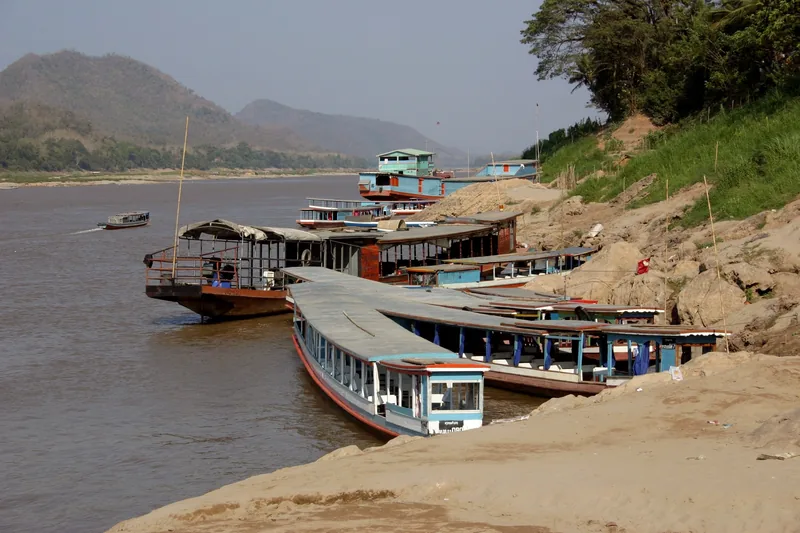
Example itinerary — fully customizable
Thailand & Laos
Nine days, one bridge, and two days on the river to Luang Prabang.
View journeyStart planning
Let’s plan your journey
Five quick questions. Your coordinator will take it from there.
Prefer to talk? WhatsApp or call+84 904 511 319